
x

Empowering in-store shopping with
AI-driven personalization
Combining live data with personalization to help shoppers feel supported and retailers connected

Timeline
7 months, January - August 2025
Client
ENAiBLE, Carnegie Mellon University’s retail collective
Project Goal
Design a solution for retailers to successfully implement in-store personalization that helps shoppers feel supported and not encroached on
Design Lead;
2 designers, 1 researcher, 1 engineer, 1 PM
Role + Team
x
Empowering in-store shopping with AI-driven personalization
Role + Team
Design Lead / Team: Ray Xia (Design), Alyssa Ogle (Research), Naimah Jangha (Product), and Storm Wright (Development)
Client
ENAiBLE, Carnegie Mellon’s retail collective with industry stakeholders such as American Eagle Outfitters
Project Goal
Design an in-store personalization solution that helps shoppers feel supported and not intruded on
Online retail is more personalized than ever, yet 90% of shoppers describe in-store shopping negatively, costing retailers $262 billion in lost sales anually.
Online retail is more personalized than ever, yet 90% of shoppers describe in-store shopping negatively, costing retailers $262 billion in lost sales anually.
hundreds of Tiktok videos express shopper frustration with in-store experiences
Through our research we found a root cause: retailers are designing the in-store shopping experience for data and not support, leaving shoppers overwhelmed.
Through our research we found a root cause: retailers are designing the in-store shopping experience for data and not support, leaving shoppers overwhelmed.
"…65 % of the time we do not know who's shopping"

"Shopping in-store is.. overstimulation..."

"…65 % of the time we do not know who's shopping"
Retailer
"Shopping in-store is overstimulation...
Shopper
Though overwhelmed, shoppers still want to evaluate products in-store. So, we designed to augment that experience.
Though overwhelmed, shoppers still want to evaluate products in-store. So, we designed to augment that experience.
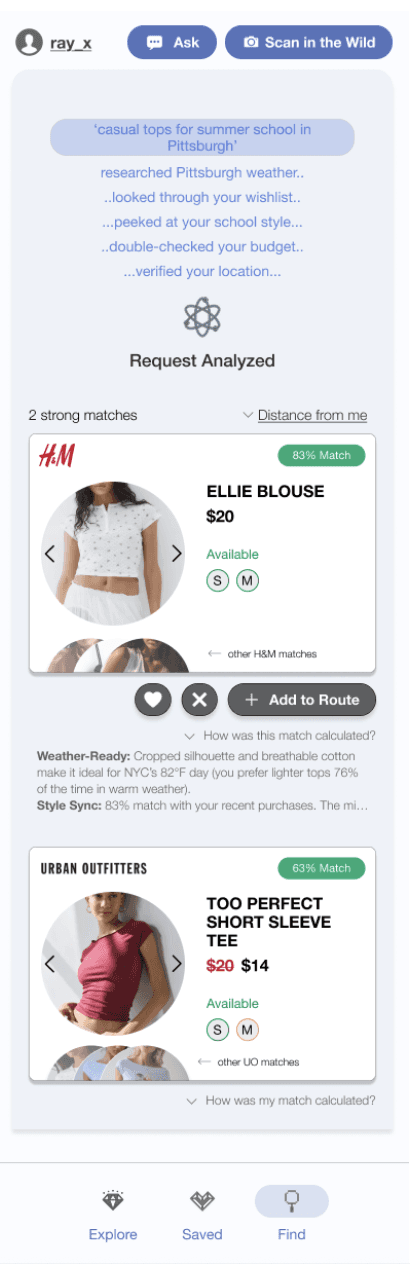
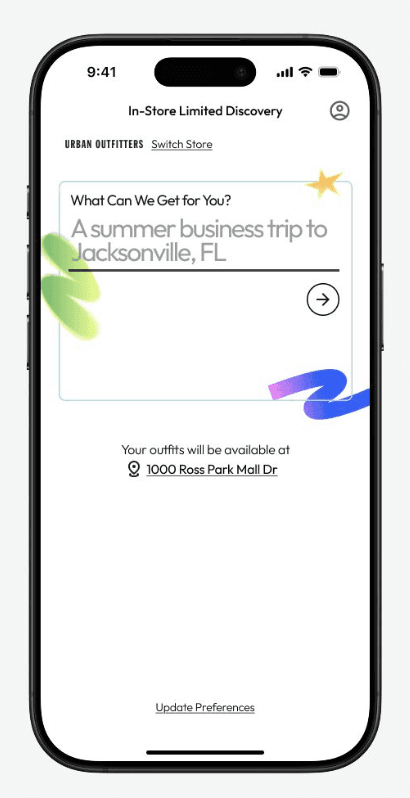
Cerulean is built to support from the preparation phase of shopping – from curating products, verifying stock, and mapping a route through the store.
Cerulean is built to support from the preparation phase of shopping – from curating products, verifying stock, and mapping a route through the store.
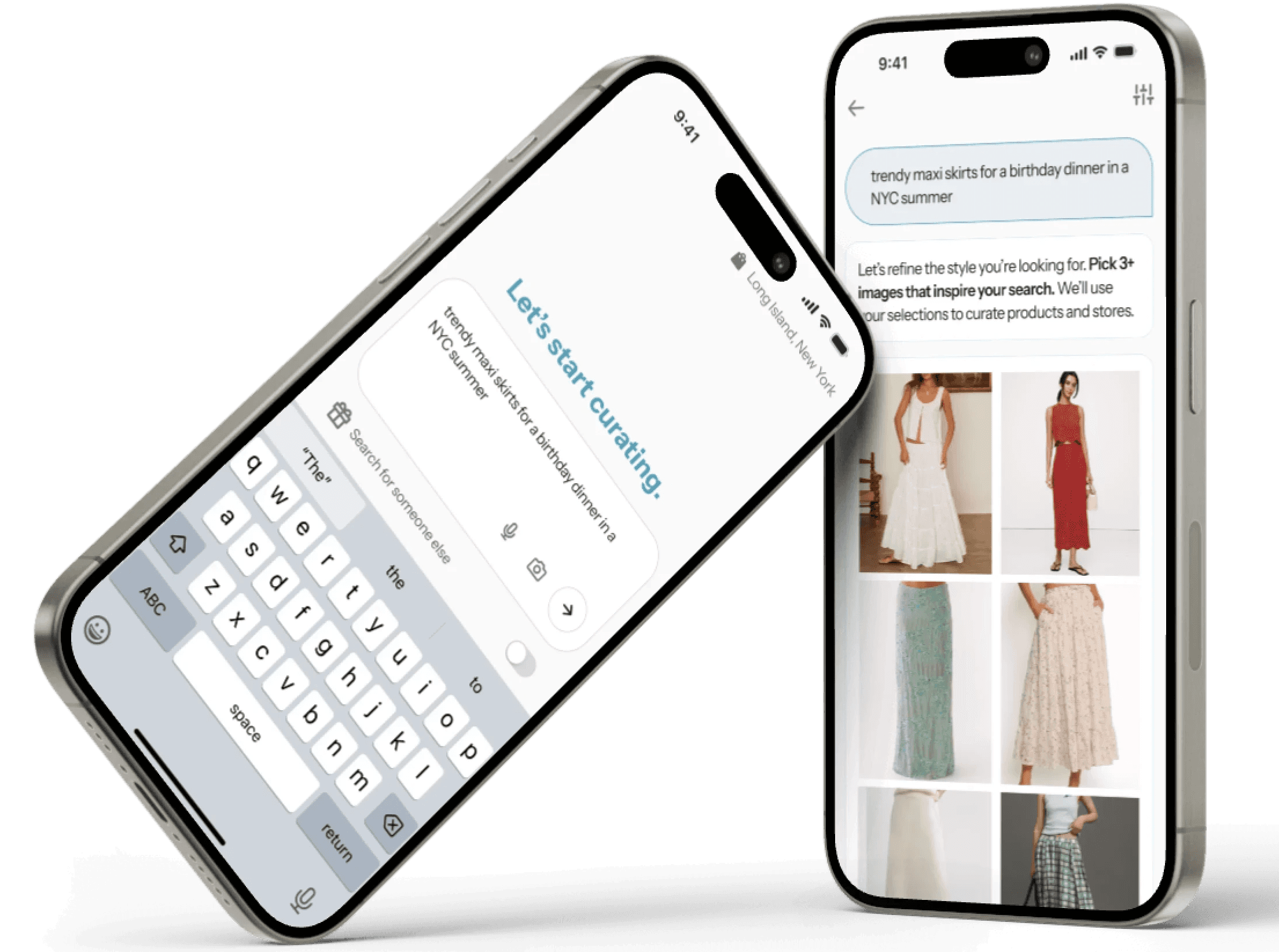
Leveraging AI, Cerulean first curates products through a process that mirrors how modern shoppers search
Cerulean supports the prep phase through five features:
(1) Search, (2) Smart Filters, (3) Visual Refine, (4) Stock + Distance Match List, and (5) Live Shopping Map.
1
Contextual Search
Natural language search that understands how shoppers actually describe clothes.
Natural language search that understands how shoppers actually describe clothes.
2
Smart Product Filters
Auto applied filters narrowing results by saved preferences so shoppers don’t have to.
Auto applied filters narrowing results by saved preferences so shoppers don’t have to.
3
Visual Refine
Pinterest-like process to curate products visually.
Pinterest-like process to curate products visually.
Then, Cerulean completes the prep phase by surfacing what's in stock and where to find it
Cerulean supports the prep phase through five features:
(1) Search, (2) Smart Filters, (3) Visual Refine, (4) Stock + Distance Match List, and (5) Live Shopping Map.
4
Stock + Distance Match List
Prioritized, location-aware list showing in-stock items that met criteria.
Prioritized, location-aware list showing in-stock items that met criteria.
5
Live Shopping Map
In-store navigation with live product updates and suggestions as shopper visits different products.
In-store navigation with live product updates and suggestions as shopper visits different products.
Problem
Apparel retailers are losing $262B in in-store sales because of the shopping experience they're providing.*
Through interviews with 40+ retailers and shoppers we learned that shoppers are desperately overwhelmed with in-store shopping and retailers are drowning in the noise of products.
*Forsta's 2024 retail customer experience study, **McKinsey & Co Next in Personalization 2021 Report
"Shopping in-store is overstimulation... I get really antsy if I can't find something, and I'm looking and looking and looking, I'm like, there's no point of me being here.."
– DL, 25 year old shopper
"Shopping in-store is.. overstimulation... I get really antsy as well if I can't find something, and I'm looking and looking and looking... I'm just like, there's no point of me being here let's move on.."
Foundational Insight
In-store personalization is the answer - but there's an absence of data to make it happen.
We also learned that retailers are data starved when it comes to in-store shopping. As such, they’re trying to gather data from customers through every means possible.
“Without a rewards account to associate with a purchase, we miss a very large area of data...65% of the time we do not know who's shopping.”
– UX Researcher at American Eagle Outfitters
“Without a rewards account to associate with a purchase, we miss a very large area of data...65% of the time we do not know who's shopping.”
– UX Researcher at American Eagle Outfitters
Retailer's data collection is leaving shoppers exacerbated and their needs unattended. Shoppers want tools to support their shopping journey, but instead are receiving overwhelming data requests that don’t seem to provide value.
Retailer's data collection is leaving shoppers exacerbated and their needs unattended. Shoppers want tools to support their shopping journey, but instead are receiving overwhelming data requests that don’t seem to provide value.
The Big A'HA
The retailer approach to personalization, one which extracts the most possible data from shoppers, is a failing recipe.
Design Implication
Our in-store personalization solution can serve as a data bridge between shopper and retailer.
Analysis + Journey
A successful solution would create enough value for shoppers to earn their trust and ultimately, data.
A successful solution would create enough value for shoppers to earn their trust and ultimately, data.
After a detailed analysis of our journey maps and personas, we honed in on the preparation phase of the in-store shopping journey.
After a detailed analysis of our journey maps and personas, we honed in on the preparation phase of the in-store shopping journey.
taking a look at the in-store journey and its pain points

Preparation
Fragmented + tiring information gathering
Exploration
Too many options + unclear navigation
Evaluation
Analysis paralysis + exhaustion
Decision
Unintentional purchases
taking a look at the in-store journey and it's pain points

Designing for the Prep phase allowed us to leverage existing behavior (80% of shoppers already prep for their shopping before going in-store!) to positively affect the journey downstream.
Prototyping: Experimentation
Through 30 rapid prototyping experiments, we tested shopper needs and openness to our AI-enabled ideas.
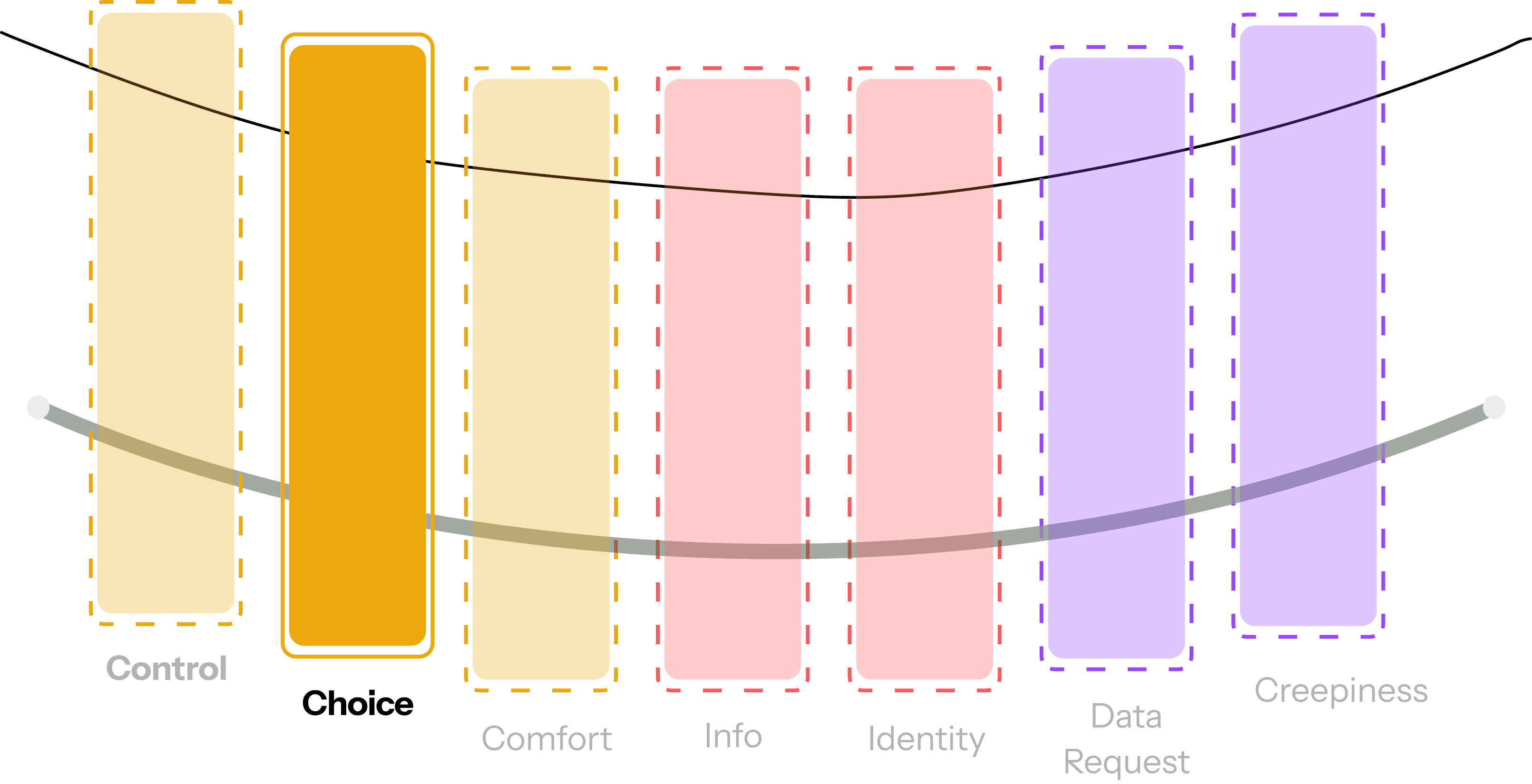
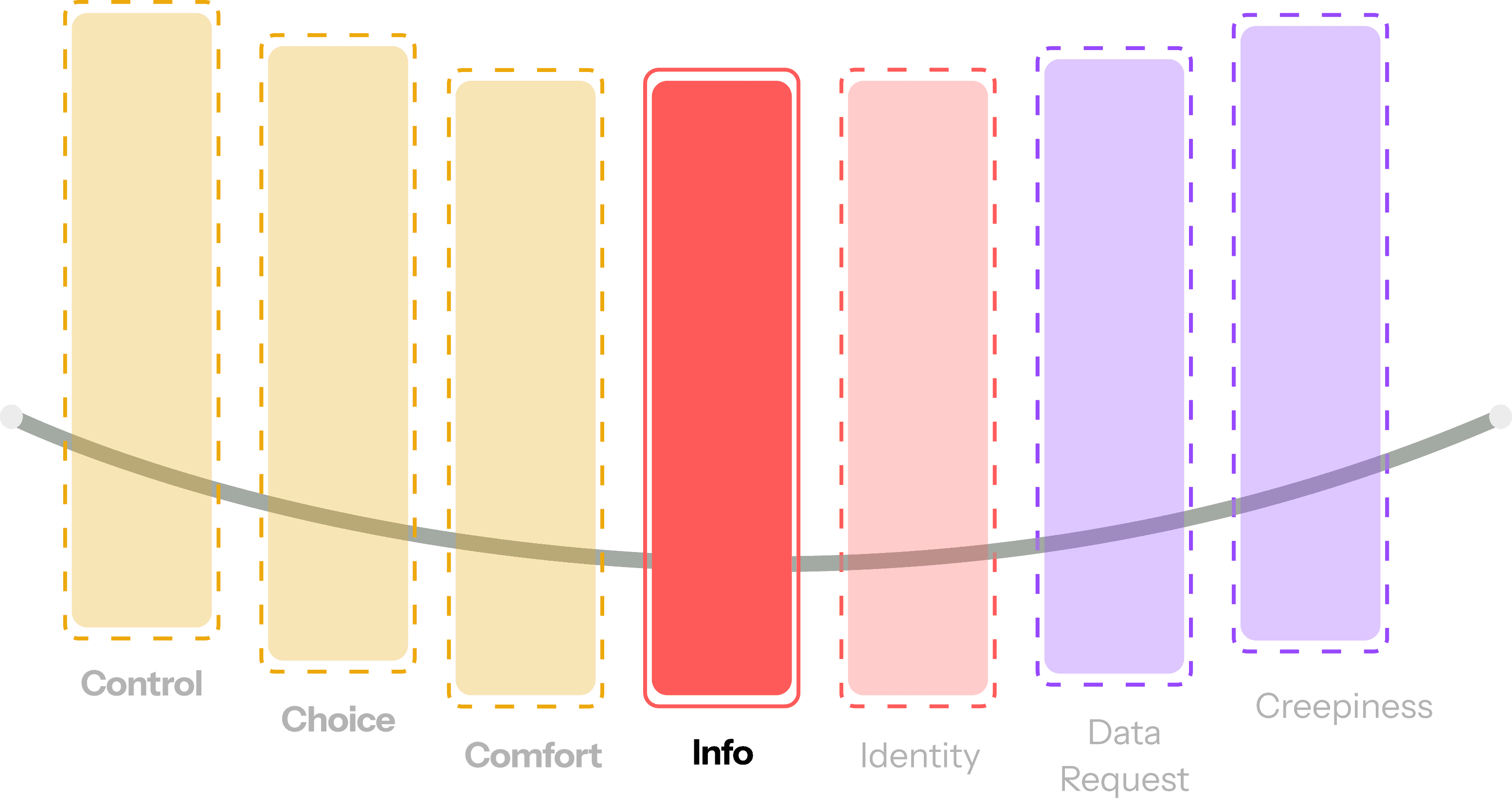
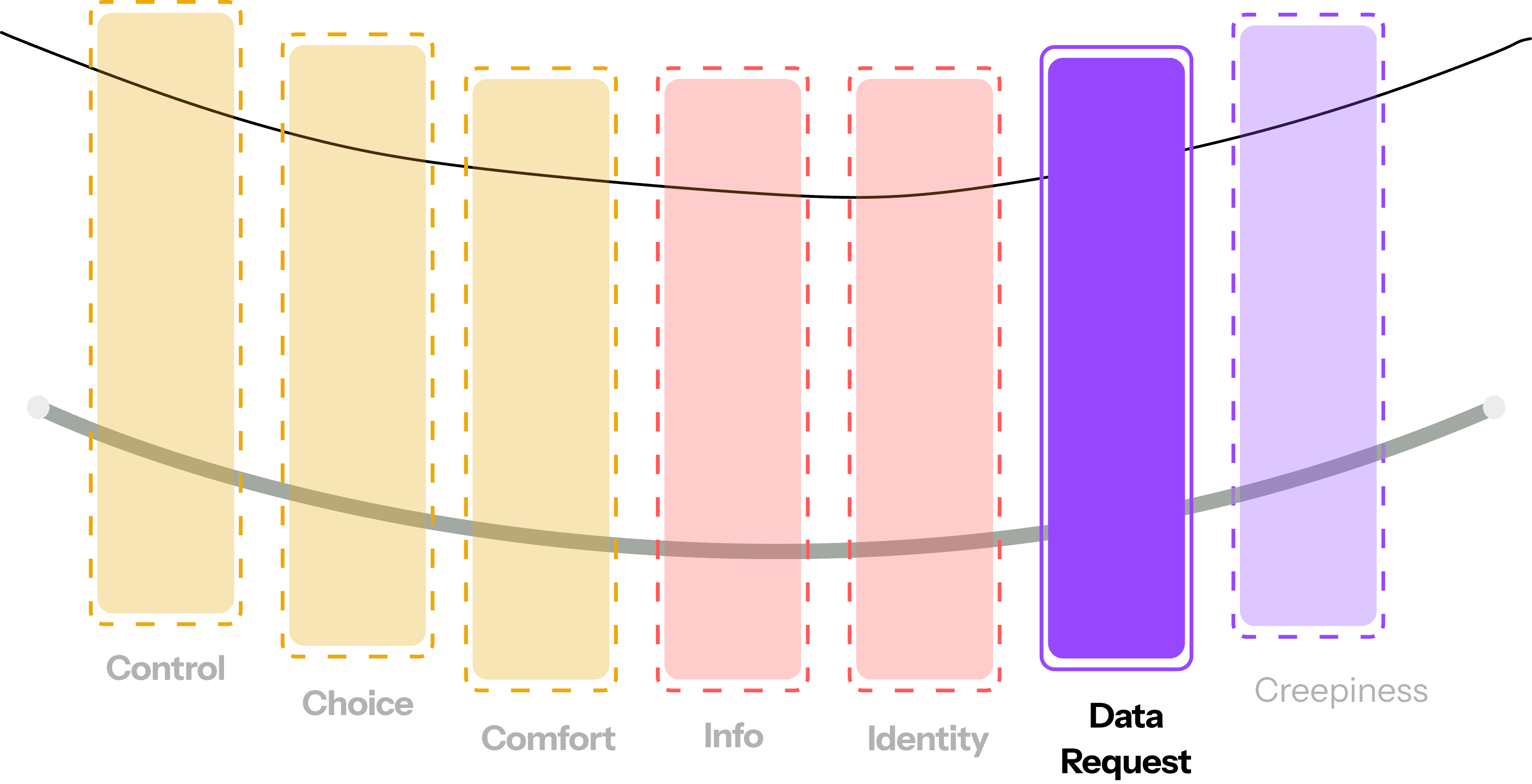
The top shopper needs we uncovered were Autonomy, Confidence, and Respect around data sharing. We broke down each need further to test boundaries and ultimately form our design principles.
key shopper needs overlayed on our data-bridge metaphor
Control
Control
Choice
Choice
Comfort
Comfort
Info
Info
Identity
Identity
Data Request
Data Request
Creep-iness
Creep-iness
Autonomy
Autonomy
Confidence
Confidence
Respect
Respect
each need contributed to a design principle



Prototyping: Low-Fidelity
Our final features balanced feasibility and desirability.
To understand desirable features, we presented shoppers with various concepts that accomplished different jobs in the preparation phase.
concept-testing stimuli




from left to right:
wishlist tracker, AI-enabled search engine, social gift guide, in-store curation tool for sales associates
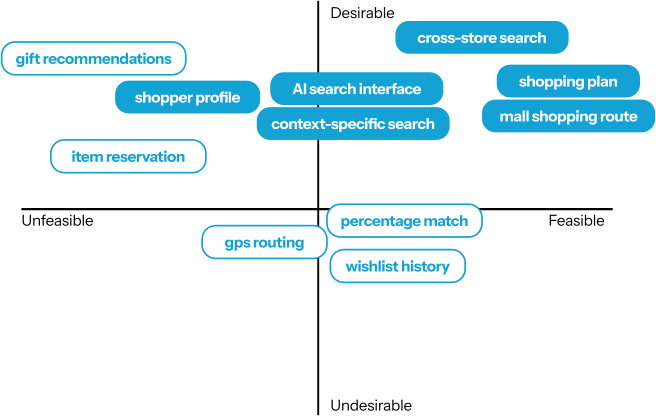
We then measured the feasibility of each feature weighed against its desirability.
evaluating features by feasibility + desirability
Undesirable
Undesirable
Feasible
Feasible
Desirable
Desirable
Unfeasible
Unfeasible
to arrive at our product, Cerulean an:
that enables
that enables
informed by a
informed by a
with a
with a
and generates an actionable
and generates an actionable
Prototyping: High Fidelity
With our concept and features finalized, we ran 3 rounds of usability testing to refine our flows, design system, and value offering.
We conducted intercepts, A/B tests, and moderated usability tests with 20 shoppers. Specifically, we tested for task completion, interest, and error rates.
These were some of the design decisions coming out of our testing.
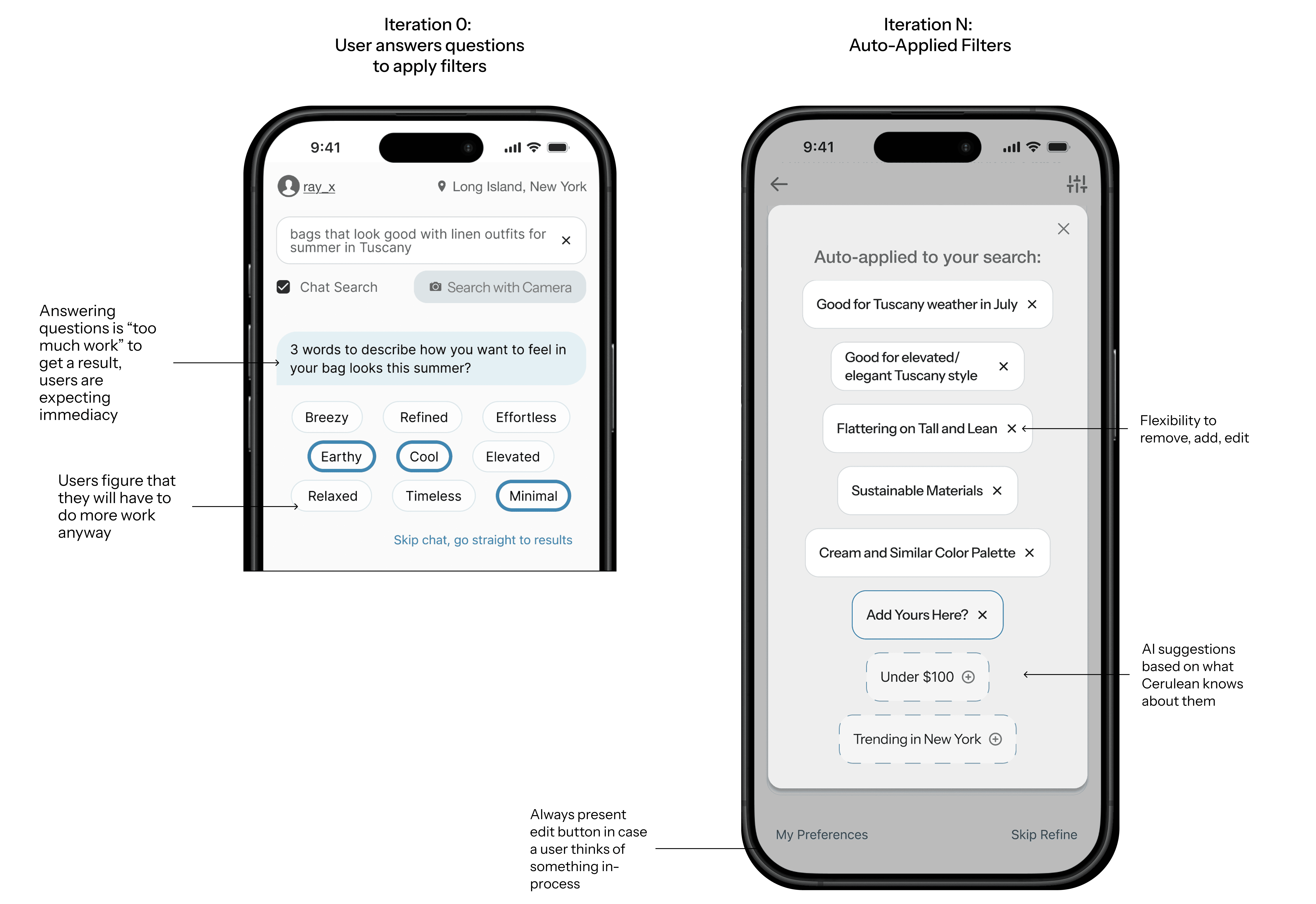
Q1
How and when should our AI filters be applied to a search?
Insight
Shoppers would rather spend time correcting filters than refining their algorithm up-front.
Design Decision
Collect enough data to auto-apply mostly correct filters, and allow shoppers to edit whenever.
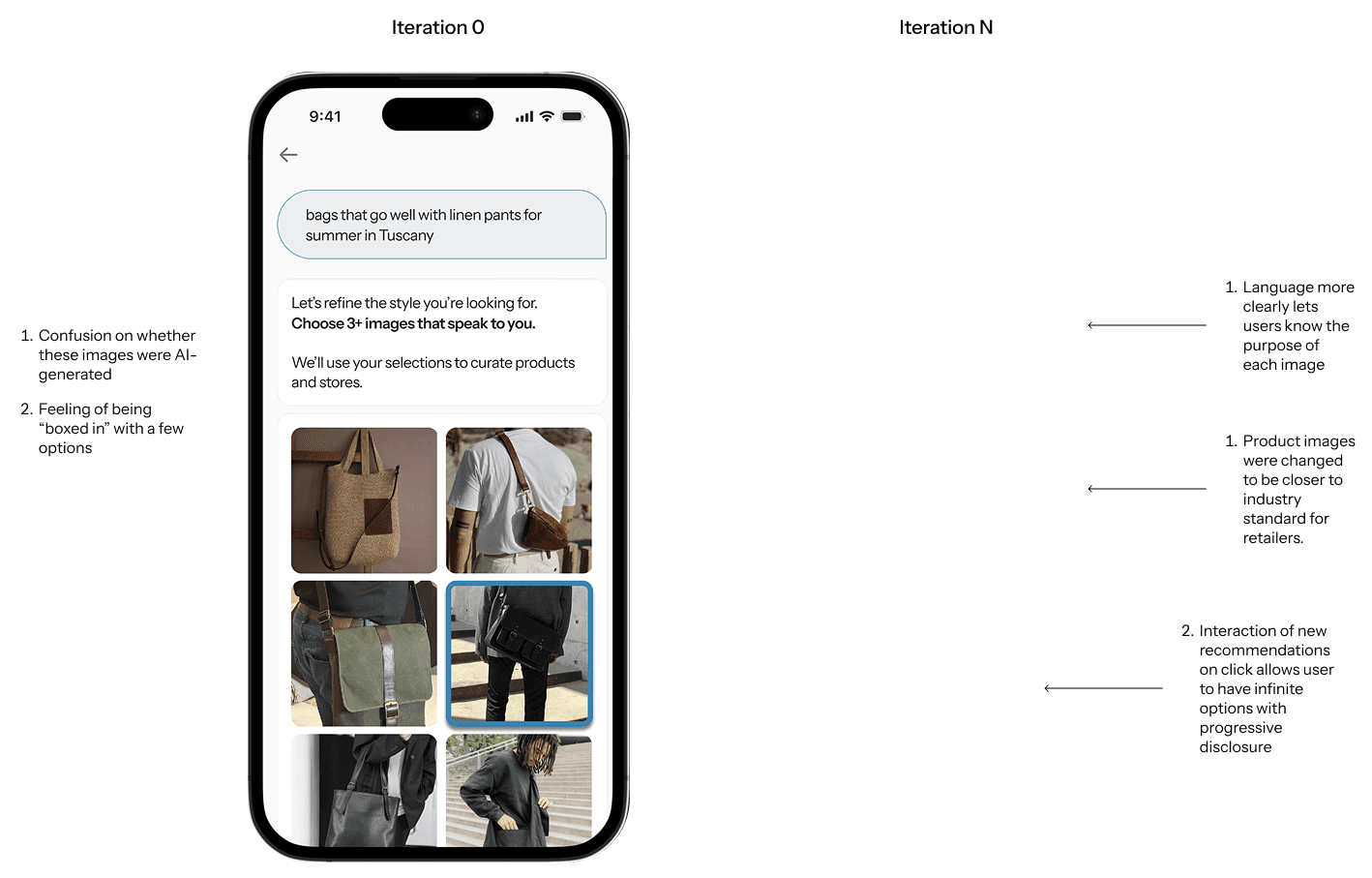
Q2
Do users understand and value the visual approach to algorithm refinement?
Insight
Visual product refinement is a new retail paradigm - one that may initially confuse users but resonates once understood.
Design Decisions
Clarify instructional language and design interactions that mirror the flexibility AI tools they're used to using gives them.
Q3
How can our product cards support informed, yet quick decisions?
Insight
Shoppers want ALL product information, but some are more critical than others.
Design Decision
Balance information access and cognitive ease through progressive disclosure that prioritizes the 5 most time-relevant pieces of information:
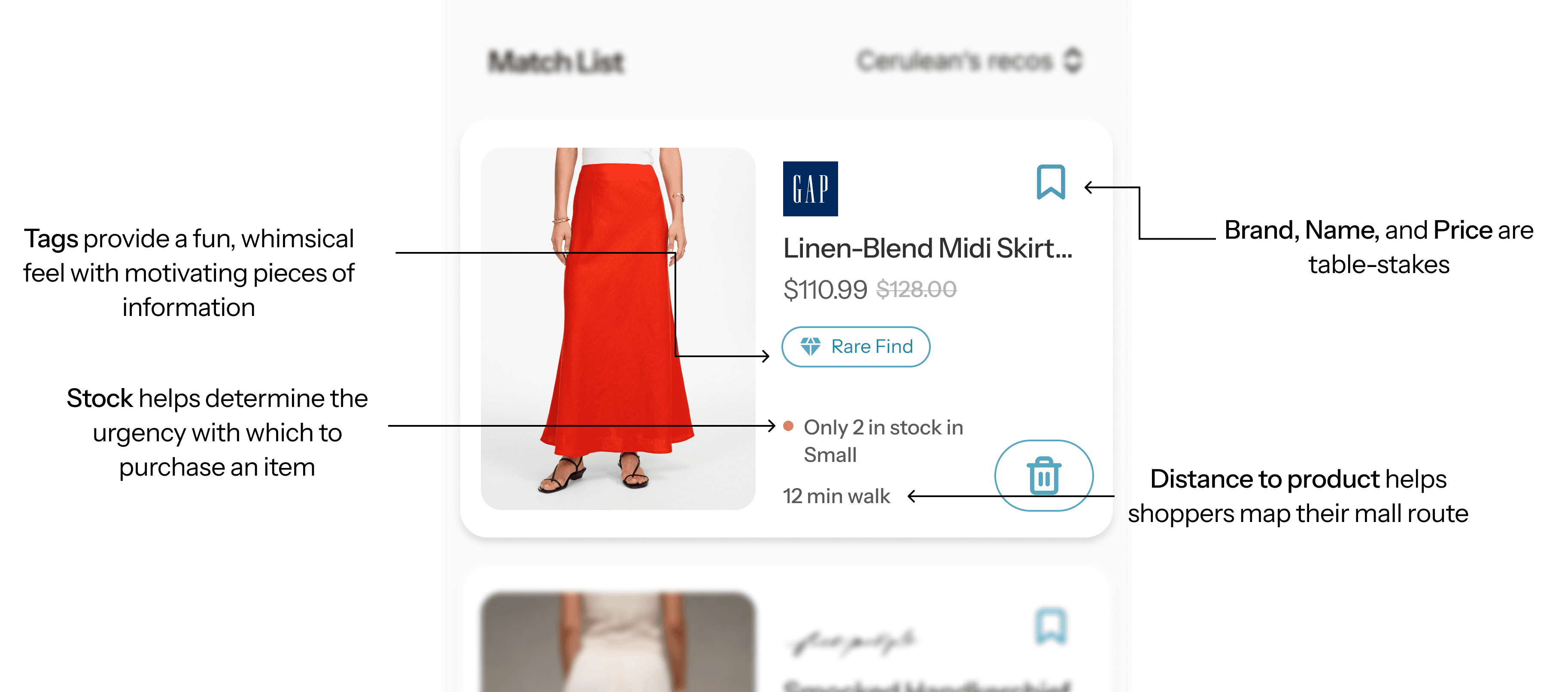
Final Features
Contextual Search
Search that considers shoppers full context to surface accurate, in-stock options across brands.
Solving for overwhelming results in planning by filtering out irrelevant and out-of-stock items.
Visual Search Refinement
Intuitive, Pinterest-like visual process that lets shoppers narrow results based on the details that matter most to them.
Solving for the gap between style ideas and tangible results with an intuitive, visual narrowing process.
Curated Match List
Prioritized, location-aware list showing in-stock items that met budget, size, and context criteria.
Solving for out-of-stock surprises by giving shoppers a ready-to-buy, prioritized list.
Smart Filters
Auto applied filters narrowing results by previous preferences so shoppers don’t have to.
Solving for mental effort of filtering results by remembering preferences and updating automatically, keeping results relevant without repetition.
Plan Map
In-store navigation with live updates as shopper visits different products on their shopping plan.
Solving for physical shopping fatigue by helping plan efficient trips and avoid wasted stops.
Success Metrics
8 out of 10 of our final testers expressed a willingness to pay 99 cents to download Cerulean.
And though we prioritized shopper needs in our design to begin, our strategy always considered retailer needs. We consulted with 8 major retailers constantly, ensuring that we were keeping their constraints in mind.
Through demos with retailers like Walmart and American Eagle Outfitters, we confirmed that the business case resonated. However, with more time we would have launched more formal pilots to pressure test retailer interest and measure barriers.
"An app that delivers personalized style recommendations while also aggregating prices, store locations, and retailer availability would be a game-changer - especially for reviving foot traffic in physical retail spaces."
– Former Senior Manager at Macy's, Inc.
"Delivering personalized style recommendations while also aggregating prices, store locations, and retailer availability would be a game-changer - especially for reviving foot traffic in physical retail spaces."
– Former Senior Manager at Macy's, Inc.
Innovation Product Managers, Design Leaders, and Design Retail consultants representing 10+ major retailers contributed to our final design
Cerulean would [get me to go in store] if I found the right item, like that plum J. Crew sweater for example. I never would have guessed J. Crew had some stuff like that.
- WP, 25-year-old male shopper
Cerulean would [get me to go in store] if I found the right item, like that plum J. Crew sweater for example. I never would have guessed J. Crew had some stuff like that.
- WP, 25-year-old male shopper

7 of 10 shoppers who tested the final product said they would be more willing to go in-store if they had a tool like Cerulean
Feel free to explore our live MVP here:
Thank you for reading!
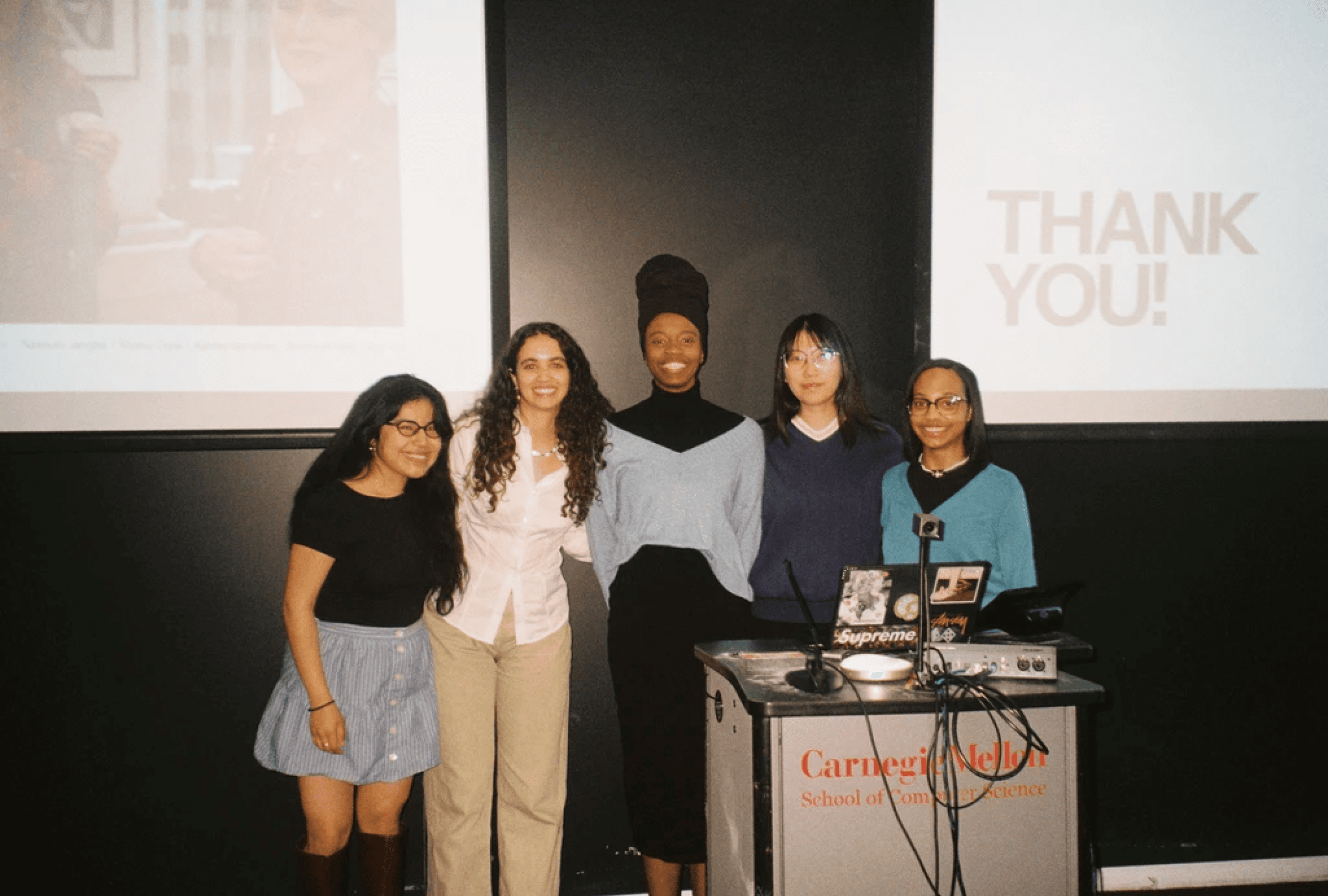

Thanks for stopping by!
Let's connect?


Thanks for stopping by!
Let's connect?
Thanks for stopping by!
AS
AS
Client
ENAiBLE, Carnegie Mellon University’s retail collective
Role + Team
Design Lead; 2 designers, 1 researcher, 1 engineer, 1 PM
Project Goal
Design a solution for retailers to successfully implement in-store personalization that helps shoppers feel supported and not encroached on
Retail is more advanced than ever, yet 90% of shoppers describe in-store shopping negatively, costing retailers $262 billion in lost sales anually.
The modern retailer-shopper dynamic exacerbates two acute, reinforcing pain points: retailers are underinformed and shoppers are overwhelmed.
"…65 % of the time we do not know who's shopping"
"Shopping in-store is overstimulation...
Cerulean seeks to bridge the gap between retailer and shopper needs through five key features.
Cerulean supports the prep phase through five features:
(1) Contextual Search, (2) Visual Refine (3) Smart Product Filters, (4) Stock + Distance Match List, and (5) Live Shopping Map.
1
Contextual Search
Natural language search that understands how shoppers actually describe clothes.
2
Smart Product Filters
Auto applied filters narrowing results by saved preferences so shoppers don’t have to.
3
Visual Refine
Pinterest-like process to curate products visually.
4
Stock + Distance Match List
Prioritized, location-aware list showing in-stock items that met criteria.
5
Live Shopping Map
In-store navigation with live product updates and suggestions as shopper visits different products.
Retail is more advanced than ever, yet 90% of shoppers describe in-store shopping negatively, costing retailers $262 billion in lost sales anually.
The modern retailer-shopper dynamic exacerbates two acute, reinforcing pain points: retailers are underinformed and shoppers are overwhelmed.
"…65 % of the time we do not know who's shopping"
"Shopping in-store is overstimulation...
Cerulean seeks to bridge the gap between retailer and shopper needs through five key features.
Cerulean supports the prep phase through five features:
(1) Contextual Search, (2) Visual Refine (3) Smart Product Filters, (4) Stock + Distance Match List, and (5) Live Shopping Map.
1
Contextual Search
Natural language search that understands how shoppers actually describe clothes.
2
Smart Product Filters
Auto applied filters narrowing results by saved preferences so shoppers don’t have to.
3
Visual Refine
Pinterest-like process to curate products visually.
4
Stock + Distance Match List
Prioritized, location-aware list showing in-stock items that met criteria.
5
Live Shopping Map
In-store navigation with live product updates and suggestions as shopper visits different products.
Apparel retail has an in-store personalization problem. Both shoppers and retailers want it, but neither is getting it.
Through interviews with 40+ retailers and shoppers we learned shoppers are desperately overwhelmed with in-store shopping and retailers are drowning in the noise of products.
"Shopping in-store is.. overstimulation...I'm like, there's no point of me being here.."
Problem
In-store personalization is being blocked by an absence of data to make it happen.
We also learned that retailers are data starved when it comes to in-store shopping. As such, they’re trying to gather data from customers through every means possible.
Retailer's data collection is leaving shoppers exacerbated and their needs unattended. Shoppers want tools to support their shopping journey, but instead are receiving overwhelming data requests that don’t seem to provide value.
"…65 % of the time we do not know who's shopping"
Foundational Insight
The Big A'HA
The retailer approach to personalization, one which extracts the most possible data from shoppers, is a failing recipe.
Design Implication
Our in-store personalization solution can serve as a data bridge between shopper and retailer.
We had to design a solution which would create enough value for shoppers to earn their trust and ultimately, data.
Analysis + Synthesis
After a detailed analysis of our journey maps and personas, we honed in on the preparation phase of the in-store shopping journey.
Designing for the Prep phase allowed us to leverage existing behavior (80% of shoppers already prep for their shopping before going in-store!) to positively affect the journey downstream.
Preparation
Fragmented + inefficient information gathering
Exploration
Too many options + unclear navigation
Evaluation
Analysis paralysis + exhaustion
Decision
Unintentional purchases
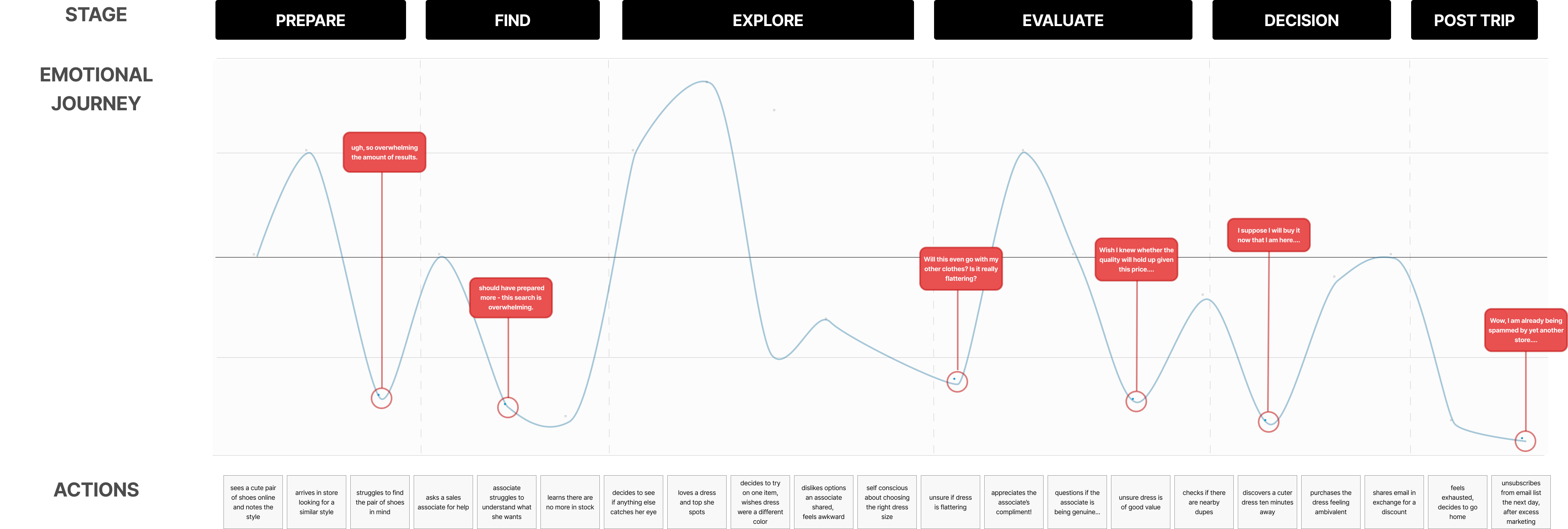
taking a look at the in-store journey and its pain points
We set out to solidify our features by exploring shopper priorities through 30 rapid prototyping experiments.
The top shopper needs we uncovered were Autonomy, Confidence, and Respect around data sharing. We broke down each need even further to test specific boundaries and ultimately form our design principles.
key shopper needs overlayed on our data-bridge metaphor
Control
Choice
Comfort
Info
Identity
Data Request
Creep-iness
Autonomy
Confidence
Respect
each need contributed to a design principle
Parallel Prototyping
After testing concepts through UI wireframes, we arrived at a final set of features through an evaluation of feasibility and impact.
Iterative Prototyping
We first presented shoppers with preparation tools that accomplished different tasks.
concept-testing stimuli
from left to right: wishlist tracker, AI-enabled search engine, social gift guide, in-store curation tool for sales associates
We then analyzed the features our testers values on a matrix to land at our final feature set:
evaluating features by feasibility + desirability
to arrive at our product, Cerulean an:

Prototyping: High Fidelity
With our concept and features finalized, we ran 3 rounds of usability testing to refine our UI flows, design system, and value offering.
We conducted intercepts, A/B tests, and moderated usability tests with 20 shoppers. Specifically, we tested for task completion, interest, and error rates.
These were some of the design decisions coming out of our testing.
Q1
How and when should our AI filters be applied to a search?
Insight
Shoppers would rather spend time correcting filters than refining their algorithm up-front.
Design Decision
Collect enough data to auto-apply mostly correct filters, and allow shoppers to edit whenever.
Q2
Do users understand and value the visual approach to algorithm refinement?
Insight
Visual product refinement is a new retail paradigm - one that may initially confuse users but resonates once understood.
Design Decisions
Clarify instructional language and design interactions that mirror the flexibility AI tools they're used to using gives them.
Q3
How can our product cards support informed, yet quick decisions?
Insight
Shoppers want ALL product information, but some are more critical than others.
Design Decision
Balance information access and cognitive ease through progressive disclosure that prioritizes the 5 most time-relevant pieces of information:
80% of our final testers expressed a willingness to pay 99 cents to download our app.
Final Product + Success Metrics
Contextual Search
Natural language search that understands how shoppers actually describe clothes.
Solving for overwhelming results in planning by filtering out irrelevant and out-of-stock items.
Search Refinement
Intuitive, Pinterest-like visual process that lets shoppers narrow results based on the details that matter most to them.
Solving for the gap between style ideas and tangible results with an intuitive, visual narrowing process.
Curated Match List
Prioritized, location-aware list showing in-stock items that met budget, size, and context criteria.
Solving for out-of-stock surprises by giving shoppers a ready-to-buy, prioritized list.
Smart Filters
Auto applied filters narrowing results by previous preferences so shoppers don’t have to.
Solving for mental effort of filtering results by remembering preferences and updating automatically, keeping results relevant without repetition.
Plan Map
Auto applied filters narrowing results by previous preferences so shoppers don’t have to.
Solving for physical shopping fatigue by helping plan efficient trips and avoid wasted stops.
Thanks for stopping by!
Let's connect?
Thanks for stopping by!
Let's connect?
Our solution was designed for both shoppers and retailers.
Though we prioritized shopper needs in our design to begin, our strategy always considered retailer needs. We consulted with 8 major retailers constantly, ensuring that we were keeping their constraints in mind.
While we ran out of time to pressure test retailer willingness to buy our solution, we did gauge retailer interest. Three retailers, including Walmart and American Eagle Outfitters expressed interest and support for our solution.
Thank you for reading!
I am happy to talk about the process of developing Cerulean in depth in-person!
x
Empowering in-store shopping with AI-driven personalization and insights
Combining live data with personalization to help shoppers feel supported and retailers connected